
Installation view, Pola Museum of Art, Hakone, 2021. Photo: Ken Kato
Concept — since 2021
CONTINUUM
The constitutive elements of the world / この世界を構成するもの
- Exhibition
- HIRAKU PROJECT Vol.12
- Dates
- 18 Sep 2021 – 30 Mar 2022
- Venue
- Atrium Gallery, Pola Museum of Art, Hakone
- Photo
- Ken Kato
About
Even when part of a pattern is missing, the rule behind it can still be read from the relations among the forms that remain. As long as the rule can be read, the pattern is felt to continue into what cannot be seen. Continuum is this capacity to continue across what is missing.
Continuity had long been a central theme of the practice. It was first named Continuum in the 2021 solo exhibition “CONTINUUM: The constitutive elements of the world” at the Pola Museum of Art, where Hilbert curve and Incomplete continuum marked its starting point. The texts below were written for that exhibition.
模様の一部が欠けていても、残された形どうしの関係から、そこにあるはずの規則を読み取ることができる。規則が読み取れるかぎり、見えていない部分にも模様は続いていると感じられる。Continuum とは、このように欠けを越えて続いていく性質のことである。
連続することは、それ以前から一貫して制作のテーマだった。それを Continuum と名付けたのは、2021年にポーラ美術館で開いた個展「CONTINUUM|この世界を構成するもの」においてである。そこで発表した《Hilbert curve》と《Incomplete continuum》が、Continuum の出発点となった。以下に、この展示のために書かれた2つの文章を収める。
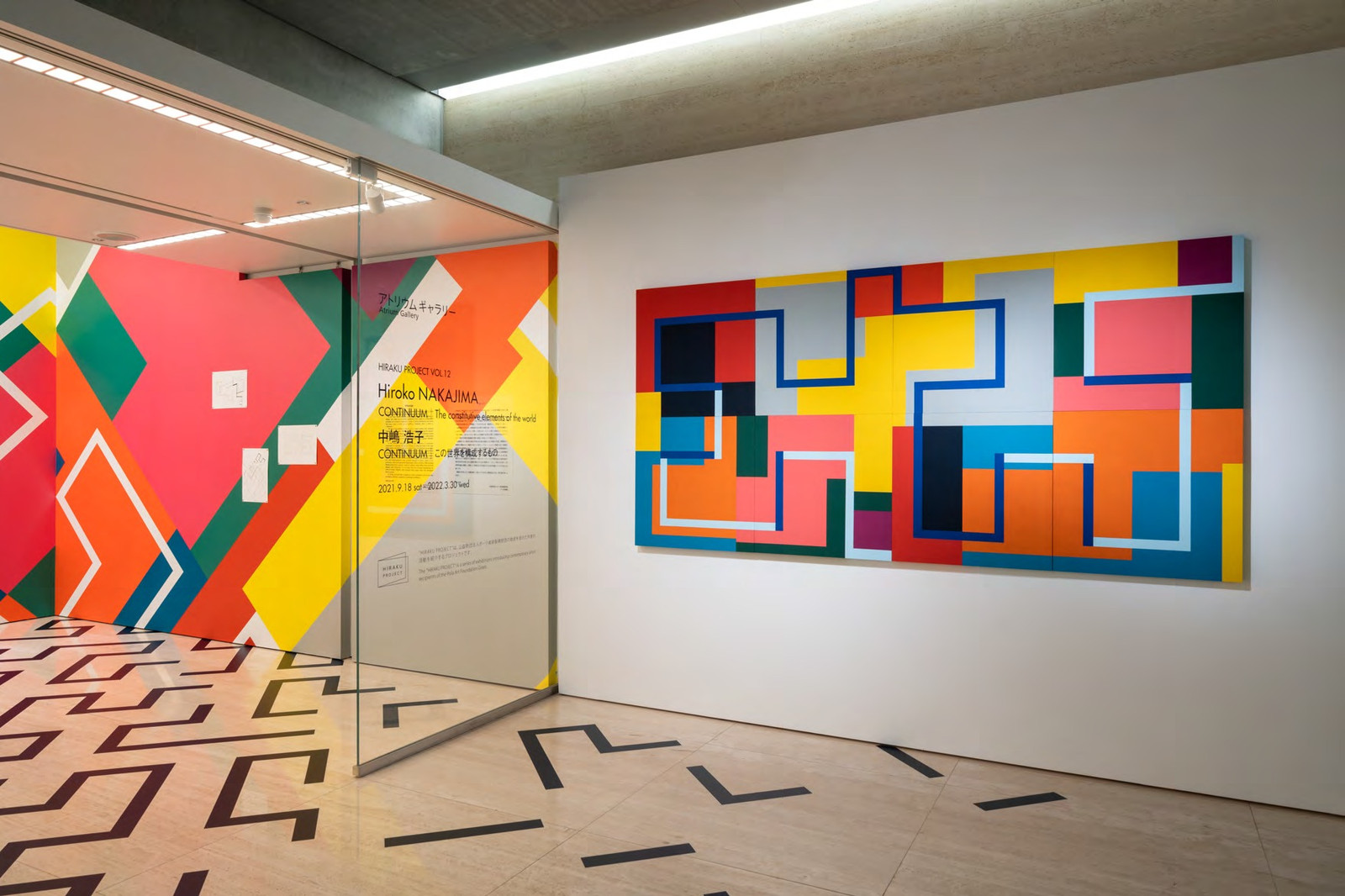

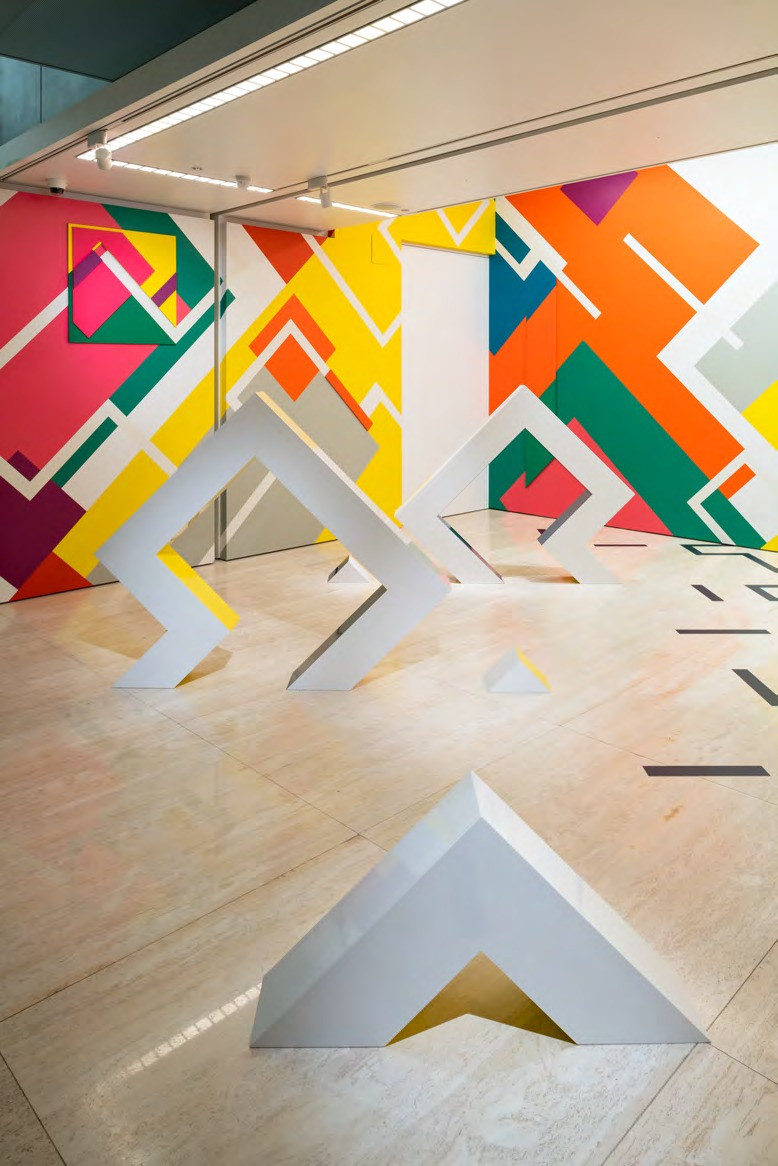
Incomplete Continuum不完全な連続体Hiroko Nakajima, 2021
We exist (in a space) within the continuous stream of time and phenomena. This state enables a point to become a line, a plane, and a space, and also allows for the creation of a world that transcends dimension, continuing infinitely.
“Why is the sky blue?”
As someone living in this world, I often found myself considering vague questions about the things I saw. For example, what exactly were things like “atmosphere” and “state,” which lay beyond the realm of scientific explanation? While continuing to consider these things, I happened to encounter mathematics in Germany, and through my relationship with a mathematician, I was able to find answers for these questions that I had long pondered.
The universe and the earth are made up of microscopic geometrical constructions that are invisible to the eye. These things are visibly manifested by constantly occurring natural phenomena. They consist of numerous patterns within countless orders. My realization that mathematics elucidated these things was supported by concepts such as “sets,” “differential geometry,” and “group theory.”
From that point on, the notion that geometric structures and continuous properties dwelled behind natural phenomena and invisible systems became the fundamental theme of my work. At the same time, mutations and errors give rise to unpredictable new substances, which are both destroyed and continually change shape.
Geometric patterns are often expressed through the theory of tessellation (or seamless vector patterns). These are widely known from the running patterns of symmetrical shapes found in places such as the inner walls of the Alhambra. My works, however, are not merely expressions of geometric patterns that conform to a given system, but rather what might be described as visual expressions that sensually capture mathematical concepts.
My recent series of works intuitively incorporates disparities, irregularities, and deficiencies contained in a continuum rather than continuing in a uniform manner. By developing running patterns as visual expressions in a plane or space, I set out to emphasize the incomplete continuums that occur in the world. I present these works under the title CONTINUUM.
My conception of this asymmetrical sensibility, characterized by disparities, irregularities, and deficiencies, is based on the idea that something incomplete leads to something new. I arrived at this view before becoming familiar with the traditional Japanese aesthetic, “Continuance lies in nothing so much as imperfect form,” which I came across in the 82nd chapter of Tsurezuregusa (Essays in Idleness). The book describes the “incomplete aesthetic,” and explains how the concept is an established part of culture, history, and architecture. As symmetry was widely seen as a perfect geometric realm in Europe, it emerged as a distinguishing feature in art, conveying a stronger sense of reality.
In this exhibition, I have used the Hilbert curve, a mathematical space-filling curve, as a motif. This continuum theory holds that by extending a bendable line with moving points, it is possible to fill in a plane or space. I hope that you will imagine an invisible world and experience the entire exhibition space as you trace the lines and colors.
The space is an incomplete continuum that comprises an entire world, which will continue on into the future, and is also a fragment of this unending world.
わたしたちは、時間や現象という「連続」した流れの中(空間)に存在しています。連続することで、点から線、面、空間となり、次元を超えて世界を構築し、何次元までも続いていくことができます。
「なぜ、空は青いのだろうか?」
この世界を生きる一人の人間として、何かものを見るたびに漠然とした疑問を抱いていました。科学で説明されるものの外にある、「雰囲気」や「様子」が何であるのか。このような感覚を持ち続けてきた中、ドイツで数学に出会い、数学者との関わりの中でずっと抱いてきた疑問の答えが見つかりました。
宇宙や地球は、目に見えないミクロな幾何学的構造によって成り立ち、わたしたちの目に見えるマクロの連続的な自然現象となって現れています。それらは多数のパターンから成り立ち、多くの秩序が存在しています。それを解明してきたのが数学であったのだと、「集合」、「微分幾何学」、「群論」などの概念により感じました。
以来、自然現象や見えないシステムの背景に幾何学的な構造や連続的な性質があるということが、わたしの作品の根幹をなすテーマとなりました。それと同時に、連続する中で起こる変異やエラーなどが、予期せず新たな物質を生みだし、それらは破壊されて形を変え続けてきました。
幾何学模様は、主に「敷き詰め模様」と言われる平面充填(テセレーション)の理論で表現することが多く、アルハンブラ宮殿の内壁のようなシンメトリーを基本とした形の連続模様として広く知られています。私の作品は、それらのシステムに則った「数学的な模様」としての表現だけではなく、「数学の概念を感覚的に捉えた視覚表現」と言うことができます。
近年制作した私の作品は、均一に続いていくのではなく、連続性の中に「ズレ、変則、欠如」を感覚的に取り込み、連続した模様を平面や空間に視覚表現として展開していくことで、この世界の中で起こる不完全な連続性を重ねています。これをわたしは「CONTINUUM|連続体」として提示しています。
「ズレ、変則、欠如」などに特徴づけられる私のアシンメトリックな感覚は、「完璧ではない形だからこそ、続きがある」という日本古来の美意識が、「未完成だから次につながる」という意識として知らぬうちに自分の中に根付いていたのだと、『徒然草』第82節を読んで実感しました。そこには「不完全である美意識」についての記述があり、文化、歴史、建築の世界においても美意識として完璧ではないことが定着していたことを示しています。これは、左右対称が完璧な幾何学の世界(シンメトリー)をヨーロッパで多く見たことで、より強く実感を得た感覚であり、私の作品の特徴的な部分として反映されています。
今回、モティーフとしているヒルベルト曲線は、数学の世界にある代表的な空間充填曲線であり、「点」が移動してできる「線」が折れ曲がり連続することで、「面」、「空間」を埋めていく連続性の理論です。線や色でたどることで展示空間全体を体感し、見えない世界を想像していただけたら幸いです。
この展示空間は、これからも続くこの世界を構成する不完全な連続体のひとつであり、終わらないこの世界の断片なのです。
Hiroko Nakajima From the exhibition leaflet of HIRAKU PROJECT VOL.12 “CONTINUUM: The constitutive elements of the world”, POLA MUSEUM OF ART, 2021.
A New Continuum: The Pattern Science of Hiroko Nakajima新たな連続性──中嶋浩子の図案考学Kei Osawa, 2021
Horror vacui means “fear of a void.” When we decorate our surrounding environment, we have often been driven by the urge to cover surfaces with patterns, leaving no space unfilled. The art historian Alois Riegl, who has analyzed the evolution of abstraction in decorative arts, cites the tendency to dread empty space as a primary reason for humanity’s fundamental desire to decorate. Patterns do not emerge from the technical conditions of manufacturing objects, such as textiles, but from the universal mental structure of humankind. As abstract art has evolved, our urges for ornamentation have re-emerged in various forms. One prominent example is Op Art, which entails filling pictorial surfaces according to consistent geometric rules – the artist only begins painting after clearly defining the overall composition. Meanwhile, a very different direction is that of spontaneous abstract drawing, as exemplified by Art Brut. Without determining a composition in advance, the artist starts in one corner and makes repeating patterns like proliferating cells that gradually fill the entire picture. At first glance the work of artist Hiroko Nakajima, who has been dedicated to the pursuit of continuous geometric patterns, seems to belong to the former category. But the “continuum” she seeks lies on a different vector than the space-filling strategies of Op Art.
As it happens, textiles are a point of departure for Nakajima. However, instead of weaving patterns into fabric, she prints finely drawn continuous patterns using silkscreen. As a component of an installation, fabric printed with geometric patterns is a more flexible material than paper, and patterns are transformed by the free deployment of fabric in space. Nakajima uses archaic techniques to explore complex operations that today are usually only performed on computer screens.
Another element that cannot be captured on a digital screen is Nakajima’s singular and vivid sense of color. Rather than simply seeking combinations of complementary colors, she puts together intentionally incongruous shades. When covered in these hues, the Hilbert curve – the basic pattern underlying this installation – is transformed into another pattern. Indeed, there is a reason for the sense of incongruity. In fusing geometric patterns with extraordinary color schemes, Nakajima seeks not a perfect continuum, but the accidents and chance operations that occur along the way. When a small discrepancy in a Hilbert curve occurs and the discrepancy is repeated as a pattern, new forms emerge from the slight deviation. With her freely selected forms and highly distinctive approach to color, Nakajima reveals a visual world that is simultaneously universal and unique.
The process of filling space is not limited to two dimensions. It can expand from point to line, line to plane, and plane to three-dimensional form. This installation consists of two-dimensional, three-dimensional, and mobile works, all developed from the basic form of the Hilbert curve, and all interconnected. In theory, when three-dimensional pieces proliferate according to the principle of filling space, in the same manner as two-dimensional ones, the entire gallery is completely enveloped in geometric forms. In other words, as one possibility (which it is impossible actually to experience), this three-dimensional installation hints at an art space completely filled with vibrant patterns, leaving no room for viewers.
ホラー・ヴァキュイ。直訳するなら「空間畏怖」。人間は装飾を施す際に、その表面を文様で隙間なく埋め尽くす衝動に駆られてきた。抽象装飾芸術の変遷を分析した美術史家アロイス・リーグルは、人類の根源的な装飾的欲求の主な理由として、空虚を恐れる傾向を挙げた。文様は織物などものづくりの技術的条件に起因するのではなく、人類の普遍的な精神構造から生まれたものである。抽象美術の発展とともに、この装飾的傾向は様々な形に生まれ変わった。一つの大きい流れは、オップアートに代表される、統一された幾何学的法則によって画面全体を充填する方法である。作者は全体的な構図を明確に定めたうえで描き始める。もう一つの流れは、アール・ブリュットに代表される、自発的な抽象描画である。構図を定めることなく、作者は細胞が増殖していくように同じパターンを繰り返し、片隅から徐々に画面全体を埋め尽くしていく。幾何学的パターンの追求をライフワークとするアーティスト中嶋浩子は一見、前者に属しているように見える。しかし彼女が求めている「連続性」は、オップアートの空間充填とは異なるヴェクトルにある。
偶然にも、中嶋浩子の出発点はテキスタイルである。しかし彼女は織物に文様を編み込むのではなく、緻密に描かれた連続的なパターンを、シルクスクリーンの技法をもって布に印刷する。幾何学的パターンが印刷された一反の布は、インスタレーションを構成する要素として、紙よりフレキシブルな素材である。布を自由自在に広げることによって、そのパターンは変形していく。中嶋浩子は原始的な技法をもって、いまやコンピューターの画面上でしか行わない操作を模索してきた。
デジタルの画面上では捉えられないもう一つの要素として、作品の奇抜にして鮮やかな色彩感覚がある。補色関係を単純に求めることなく、中嶋浩子の配色は違和感を生み出す。本インスタレーションの基礎的なパターンであるヒルベルト曲線も、この色彩で覆われると、別のパターンへと化ける。実際、この違和感には原因がある。幾何学的なパターンと独自の色彩感覚を融合させるなか、中嶋浩子が求めているのは完全な連続性ではなく、その合間に生じる「事故」や「偶然性」である。ヒルベルト曲線に小さいズレが生じて、そのズレがパターンとして反復されると、僅かな差異から新たなフォルムが生まれる。中嶋浩子は、ズレから生じた恣意的なフォルムと独自の色彩感覚によって、普遍的でありながらユニークな造形世界を見出した。
空間充填は平面充填に限らない。点から線、線から面、そして面から立体へと展開される。本インスタレーションは平面作品のほか、立体作品やモビール作品によって構成されている。全てがヒルベルト曲線の基礎的なフォルムの展開であり、繋がっている。立体作品が、平面作品と同じように空間充填の原理に沿って増殖していくと、展示空間全体がこの幾何学的フォルムによって隙間なく埋め尽くされる。つまり、これら立体作品が体験不能の一つの可能性として示唆しているのは、鮮やかなパターンによって完全に埋め尽くされた、鑑賞者の入る余地のない芸術空間である。
From the exhibition leaflet of HIRAKU PROJECT VOL.12 “CONTINUUM: The constitutive elements of the world”, POLA MUSEUM OF ART, 2021.


